

Campaign 08 Sponsored Brands
€704.11 in ads, €618 in attributed sales: what next?
The two visible daily ACoS values are much lower than the weekly ratio, which exceeds 100%. Both observations can be true. This example explains why you must include spend from days without sales, then connect a Sponsored Brands budget to a specific objective and a measurable next test.
In 30 seconds
Calculate the week from all cost and sales, then review what the brand budget is meant to buy.
- What we see
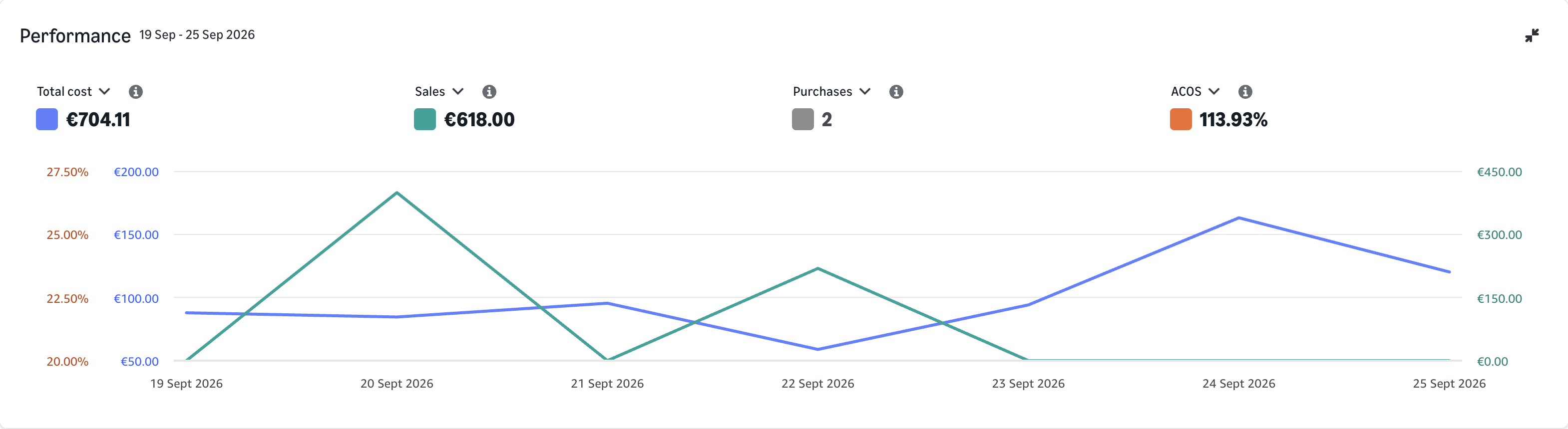
- The week reports €704.11 in spend, €618.00 in sales and two purchases, giving 113.93% ACoS.
- What to check
- Include spend from days without sales and distinguish the campaign’s sales objective from any measured brand objective.
- The next decision
- Choose one bounded test with a stated outcome rather than relying on the two daily percentages.
Observed campaign data from one advertising account. The steps below are proposals, not documented actions or measured improvements caused by Uptova.
Numbers & original evidence
- Ad spend
- €704.11
- Attributed ad sales
- €618.00
- Purchases
- 2
- ACoS
- 113.93%
View original capture
Swipe sideways to read. With a keyboard: focus the image region and use the left/right arrow keys.
Captured Enlarge original capture
The original interface is in English. The values and evidence have not been translated or recreated.
Our proposed action plan
Reconstruct the full week
Use the daily campaign export with matching attribution settings to produce a seven-day cost, sales and purchase sheet. Reconcile it to €704.11 and €618.00. Leave daily ACoS undefined without sales, and show the weekly formula beside the totals rather than averaging daily percentages.
Define the purchased outcome
Read the campaign brief and available acquisition reports to produce an objective statement with a metric and spending boundary. Separate a sales goal from an awareness or new-customer goal. If the required metric is unavailable, list that reporting need instead of adding an assumed brand benefit.
Inspect demand and destination
Use search-term and targeting reports plus the actual Store or product destination to produce a branded-versus-generic view and a short journey review. Identify a concrete testable issue, if one exists. A campaign title alone does not establish the audience, and the screenshot does not establish a broken destination.
Prepare one test
Combine the objective, journey review and current settings into one targeting, creative or destination proposal. Produce the before-state, expected observation, maximum exposure and review condition. Keep the other dimensions stable where practical so the seller can understand what the test actually changes.
The starting point
The Sponsored Brands snapshot contains €704.11 in spend, €618.00 in attributed sales and two purchases. Calculate the weekly ratio as €704.11 ÷ €618.00 × 100 = 113.93%. That means €113.93 in advertising cost for every €100 of sales credited to the campaign in this reporting view.
Spend therefore exceeds attributed sales before product costs are considered. This is an important sales-efficiency signal, not a calculation of total business profit or loss. A separate awareness or customer-acquisition objective needs its own reporting; the capture supplies no measured brand lift or new-to-brand result.
The strategic question
The daily ACoS is defined on only two days with attributed sales: approximately 21.19% and 26.89%. Other days still incur cost without sales. Averaging the two visible daily percentages would leave that cost out of the question and would not reproduce the weekly ratio.
This is why the review starts with the complete cost and sales series, not just the orange line where it appears. A gap means the daily ratio cannot be calculated; it does not mean advertising was free. Period ACoS always uses the cost and sales totals for the whole period.
Then define the campaign’s purpose. Branded navigation, generic discovery and new-customer acquisition can imply different tests. Attribution links a reported purchase to advertising; it does not measure extra customers created. Two purchases give little information about durable buying behaviour, so keep the next experiment specific and limited.
How we would judge the test
Keep total spend, attributed sales and purchases visible even when the objective extends beyond immediate sales. If new-to-brand reporting is available, describe what it reports rather than equating it with additional customers caused by the ads. Evaluate the agreed objective on consistent settings.
At the spending boundary, decide whether to stop, revise or continue the test from the observed outcome. Keep any changed rationale explicit. The useful lesson is a complete weekly calculation followed by an accountable brand decision, not a claim that an unmeasured effect makes the cost disappear.
Prepare a credible before/after
For a future test: use matching windows and reporting settings, and document price, stock and listing changes.
- 01 · Preserve the baseline
- Save all seven days of cost and sales, the original creative and destination, and the campaign’s stated objective before testing.
- 02 · Document one change
- Record one approved targeting, creative or destination test with its planned outcome and maximum exposure fixed in advance.
- 03 · Measure on equal terms
- Recompute the full-period ratio and evaluate the same objective, including spend on every day without attributed sales.
When to act — and when to wait
Do not expand from the two lower daily ratios; use the full-week result and continue only within an explicit objective, available measurement and agreed exposure limit.
Before approving a change
- Full-week cost included in ACoS
- Undefined daily ratios not averaged away
- Sales and brand objectives distinguished
- One test with a measurable review condition
The central lesson
The weekly arithmetic explains the apparent contradiction. A clear objective explains what decision comes next.
Evidence, methodology and further reading
New-to-brand share and brand lift are absent. Neither can be inferred from the two purchases.
How to read these case studies
- The high-resolution originals were captured directly in an authenticated Amazon Ads session on October 21, 2026. Every capture shows exactly one campaign in Germany. The first ten analyses cover September 19–25; five additional cases also compare September 12–18, 2026. Both weeks contain the same weekdays.
- These campaigns are a deliberately selected sample from one advertising account, not a representative average. Data is not combined across sellers. Account names, campaign names and IDs have been removed by cropping; numbers, chart lines, scales and dates are unchanged.
- ACoS = ad spend ÷ attributed ad sales. The period ratio uses period totals, not the average of daily percentages. Attributed ad sales are neither total revenue nor profit; margins, returns, taxes and organic revenue are absent from these captures.
- The five before-and-after comparisons show observed time windows, not a controlled experiment or a documented Uptova intervention. Review ideas are recommendations, not documented interventions. Lower ACoS can accompany fewer purchases; a week establishes neither durable profitability nor incremental sales.
- The captures were retaken without the pointer after the chart animation finished, then cropped only. No chart was generatively retouched. Cost, sales and ACoS use separate scales, not a shared value scale; gaps in the ACoS line can represent days without a defined daily ratio.
- Reports can use different levels of detail and attribution windows. Queries, products and placements remain separate views unless their relationship is verified. The purchased-product report discussed in these review plans shows purchases of other products but no ad cost; it cannot supply ACoS per purchased product.