
Campaign 09 Three diagnostic paths
Four purchases, 67.07% ACoS: check clicks, the offer or the bid?
A high ACoS tells you where to investigate, not which lever to pull. The useful review has three branches: whether shoppers see and click the ad, whether the offer converts those clicks, and whether the resulting sales can support the cost. Each needs a different input.
In 30 seconds
Diagnose traffic, offer and economics separately before choosing a change.
- What we see
- The campaign reports four purchases and 67.07% ACoS.
- What to check
- Recover impressions and clicks, review the actual offer, then compare cost with product economics.
- The next decision
- Choose a targeting, offer or cost response only after identifying the supported branch.
Observed campaign data from one advertising account. The steps below are proposals, not documented actions or measured improvements caused by Uptova.
Numbers & original evidence
- Ad spend
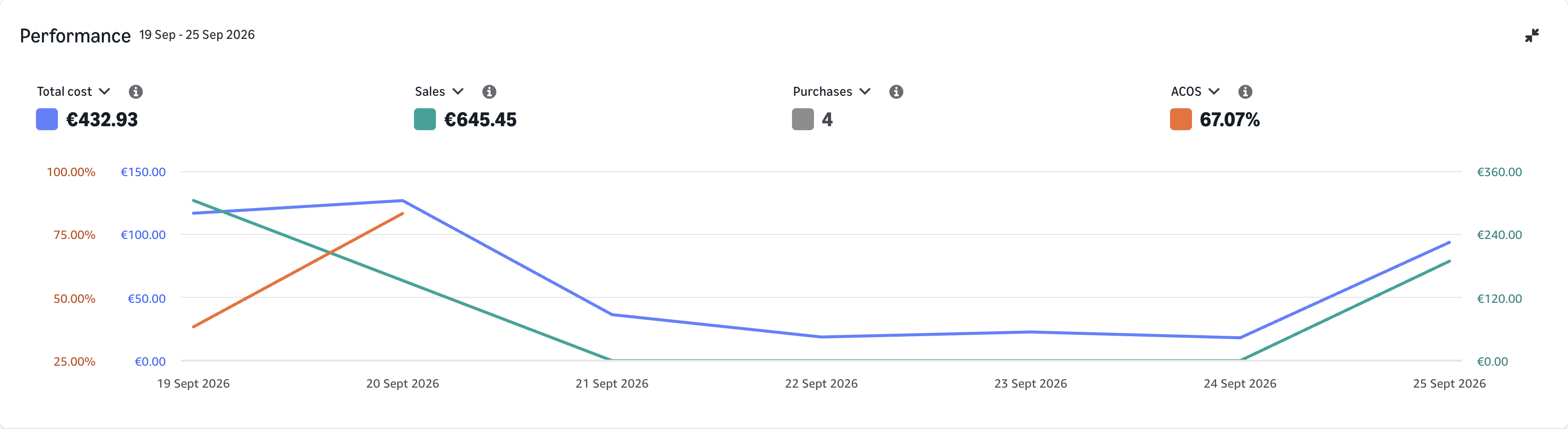
- €432.93
- Attributed ad sales
- €645.45
- Purchases
- 4
- ACoS
- 67.07%
View original capture
Swipe sideways to read. With a keyboard: focus the image region and use the left/right arrow keys.
Captured Enlarge original capture
The original interface is in English. The values and evidence have not been translated or recreated.
Our proposed action plan
Branch 1: impressions and clicks
Use the search-term and campaign reports for matching dates to produce a funnel sheet containing impressions, clicks, spend and purchases. Reconcile spend to €432.93. Calculate engagement and conversion rates only with matching denominators; if the counts are missing, record the reporting need instead of diagnosing weak traffic.
Branch 2: offer and conversion
Read the actual queries, advertised-product report, current listing and availability history. Produce an offer-fit review showing what shoppers searched for and what the product delivers. Record documented price or stock changes. A mismatch is a finding to substantiate, not something inferred from the campaign name.
Branch 3: cost and margin
Use the product cost sheet, price, fees and return assumptions to produce the margin-before-ads calculation and desired remaining contribution. Compare the advertising allowance with the affected query’s observed cost share. Include an owner-approved learning limit separately if the purpose is to gather evidence.
Choose the supported response
Combine the three branch reviews with current campaign settings to produce one proposal or a hold decision. Name the diagnosed issue, current state, proposed state, maximum exposure and review condition. Keep a bid test separate from a listing or price change where practical, rather than adjusting all three at once.
The starting point
The week shows €432.93 in spend, €645.45 in attributed sales and four purchases. At 67.07% ACoS, ads cost €67.07 per €100 in sales credited to them. This is a cost-to-sales measure, not a conversion rate and not a product profit calculation.
Exact is a narrow keyword match type, including plural forms; it still needs checking against actual searches and the advertised offer. The capture contains no clicks, impressions, query breakdown or product cost sheet. Four purchases alone cannot tell you whether the bottleneck is exposure, conversion or affordability.
The strategic question
The impressions-and-clicks branch asks whether relevant shoppers encounter and engage with the ad. The offer-and-conversion branch asks whether the actual product, price and availability fit the search. The cost-and-margin branch asks whether the sales generated at that cost leave the contribution the seller requires. Solving one branch does not automatically solve another.
Margin before ads means sales less the agreed product and selling costs before advertising. Compare that available room with the ad cost share on a consistent sales basis. Keep a learning allowance separate from routine acquisition: a seller can choose a limited test, but 67.07% does not identify an affordable bid or a universal reduction.
How we would judge the test
After an approved test, revisit the branch it was meant to address. A traffic test needs relevant impressions and clicks; an offer test needs comparable conversion evidence; a cost test needs spend, purchases and the same economic assumptions. Keep sales volume beside any improvement in ACoS.
With only four initial purchases, a later ratio can still be sensitive to a small number of outcomes. Review an equally mature attribution window and note concurrent changes. Results outside paid advertising require separate measurements; they cannot be inferred from this campaign capture.
Prepare a credible before/after
For a future test: use matching windows and reporting settings, and document price, stock and listing changes.
- 01 · Preserve the baseline
- Add matching impressions, clicks, actual searches, the product offer and economic inputs to the four-purchase starting point.
- 02 · Document one change
- Record one approved response to the supported traffic, offer or cost issue, or explicitly document a hold for missing inputs.
- 03 · Measure on equal terms
- Compare the same branch metrics and mature purchases, showing sales volume as well as any change in the cost-to-sales ratio.
When to act — and when to wait
Select a change only when one of the three branches has a supported finding and a reviewable objective; hold expansion if the funnel or economic inputs are still incomplete.
Before approving a change
- Impressions and clicks verified
- Actual offer compared with search intent
- Advertising allowance based on product costs
- One response tied to a diagnosed branch
The central lesson
The answer may be better targeting, a better offer, a cost adjustment or more evidence. The three branches tell you which one to consider.
Evidence, methodology and further reading
Without clicks and impressions, click-through and conversion rates are unknown. Results outside this paid campaign were not measured here either.
How to read these case studies
- The high-resolution originals were captured directly in an authenticated Amazon Ads session on October 21, 2026. Every capture shows exactly one campaign in Germany. The first ten analyses cover September 19–25; five additional cases also compare September 12–18, 2026. Both weeks contain the same weekdays.
- These campaigns are a deliberately selected sample from one advertising account, not a representative average. Data is not combined across sellers. Account names, campaign names and IDs have been removed by cropping; numbers, chart lines, scales and dates are unchanged.
- ACoS = ad spend ÷ attributed ad sales. The period ratio uses period totals, not the average of daily percentages. Attributed ad sales are neither total revenue nor profit; margins, returns, taxes and organic revenue are absent from these captures.
- The five before-and-after comparisons show observed time windows, not a controlled experiment or a documented Uptova intervention. Review ideas are recommendations, not documented interventions. Lower ACoS can accompany fewer purchases; a week establishes neither durable profitability nor incremental sales.
- The captures were retaken without the pointer after the chart animation finished, then cropped only. No chart was generatively retouched. Cost, sales and ACoS use separate scales, not a shared value scale; gaps in the ACoS line can represent days without a defined daily ratio.
- Reports can use different levels of detail and attribution windows. Queries, products and placements remain separate views unless their relationship is verified. The purchased-product report discussed in these review plans shows purchases of other products but no ad cost; it cannot supply ACoS per purchased product.