
Campaign 01 Automatic targeting
52 purchases from automatic targeting: which searches deserve an Exact test?
Turn useful searches found by an automatic campaign into individually reviewed Exact tests, without switching off discovery. Start with the customer query and its verified product context, not a campaign-wide bid increase.
In 30 seconds
Move supported searches into Exact tests while keeping discovery available.
- What we see
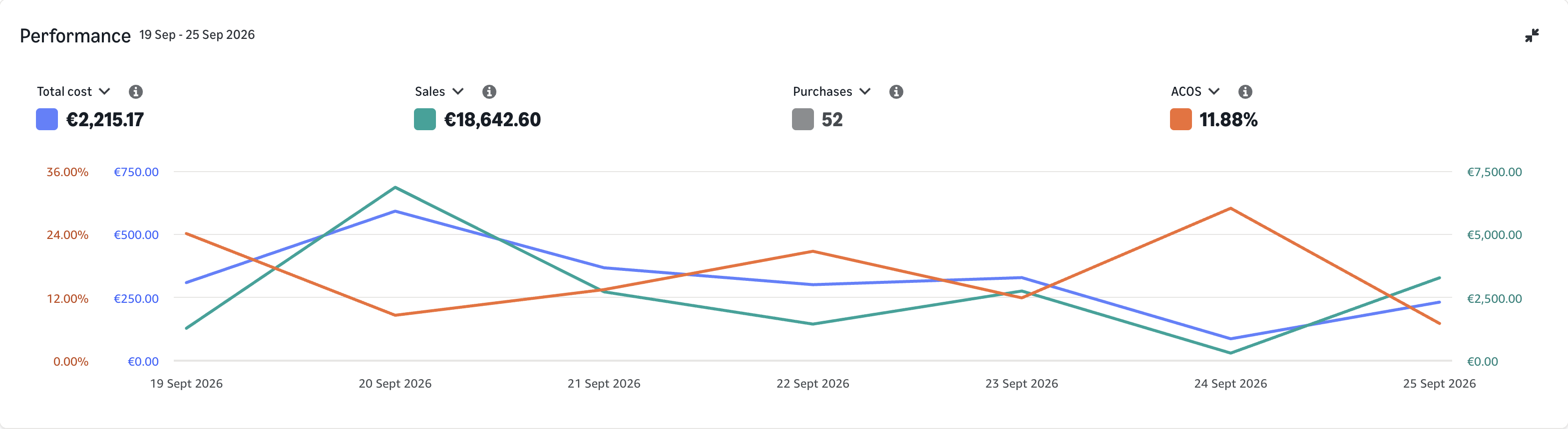
- The campaign records 52 purchases and 11.88% ACoS across the selected week.
- What to check
- Use the search-term report to identify which query–product pairs account for that result.
- The next decision
- Choose a small Exact test only where the query, product economics and existing coverage support it.
Observed campaign data from one advertising account. The steps below are proposals, not documented actions or measured improvements caused by Uptova.
Numbers & original evidence
- Ad spend
- €2,215.17
- Attributed ad sales
- €18,642.60
- Purchases
- 52
- ACoS
- 11.88%
View original capture
Swipe sideways to read. With a keyboard: focus the image region and use the left/right arrow keys.
Captured Enlarge original capture
The original interface is in English. The values and evidence have not been translated or recreated.
Our proposed action plan
Build a query shortlist
From matching search-term and advertised-product reports, connect queries to products where reporting supports that link, with spend, sales and purchases. Produce a shortlist with source campaign and dates attached. Keep unresolved links and product targets separate so only supported text queries become keyword candidates.
Add an economic boundary
Use the product cost sheet, current price and stock report to calculate the margin before ads and record the desired remaining contribution. Produce an acceptable advertising allowance for each shortlisted product. If a cost input is missing, mark that candidate for review rather than borrowing the campaign average.
Prepare the Exact destination
Compare the shortlist with the active keyword and campaign settings export. Produce a proposed destination, starting bid, spend boundary and review condition for each supported query. Check existing Exact coverage first; a new campaign is unnecessary when an appropriate destination already exists.
Keep source and destination connected
Use the proposed keyword list and source settings to produce a review sheet showing what stays in discovery and what changes. Do not add a source negative by habit. Review traffic routing separately and keep the discovery source available while the destination is being assessed.
The starting point
For September 19–25, the campaign shows €2,215.17 in spend, €18,642.60 in attributed sales and 52 purchases. Its 11.88% ACoS means €11.88 in advertising cost for every €100 in sales credited to the ads. Attribution is that reporting link between an ad interaction and a purchase; it does not establish that every purchase was additional.
Automatic targeting lets Amazon match the advertised product to searches and product contexts. The total is useful for spotting a source worth exploring, but it combines many opportunities. The daily sales curve also varies. To decide what deserves its own budget, open the search-term report rather than treating all matches as equally valuable.
The strategic question
Keyword harvesting means taking a relevant customer search found in discovery and reviewing it for manual targeting. Exact is a narrower keyword match type, including plural forms, that gives you a more specific bidding decision. It is not a guarantee of purchases. Keep the actual customer search distinct from the keyword you plan to create.
The key question is whether the query works for the advertised product at a cost the seller can accept. Margin before ads means sales revenue minus the product costs, fees and other agreed selling costs, before advertising. That leaves room for ads and the desired contribution; the campaign ACoS cannot supply those product costs.
How we would judge the test
After an approved test, review the same query and product across both source and destination. Follow their combined spend and purchases, not just the new campaign’s ACoS. Use matching attribution settings and a reporting window complete enough for a fair comparison.
The practical output is a clearer allocation: queries with their own controlled test, queries that remain in discovery, and queries needing more evidence. Record price, stock or listing changes alongside the review so a change in sales is not automatically credited to the keyword move.
Prepare a credible before/after
For a future test: use matching windows and reporting settings, and document price, stock and listing changes.
- 01 · Preserve the baseline
- Keep the campaign capture and matching query-by-product export; 11.88% is campaign context, not an individual query baseline.
- 02 · Document one change
- For an approved test, record the query, destination, bid, spend boundary and start time, with any source change listed separately.
- 03 · Measure on equal terms
- Compare combined source and destination cost and purchases for the same query–product pair after attribution has matured.
When to act — and when to wait
Test a query when its product relevance, economics and destination are clear; leave it in discovery when those inputs are incomplete, and review the test at its agreed spend boundary.
Before approving a change
- Query linked to its advertised product
- Existing Exact coverage checked
- Margin before ads and stock reviewed
- Source and destination reviewed together
The central lesson
Use the automatic campaign as a source of specific next decisions, not a reason to raise every bid.
Evidence, methodology and further reading
The campaign ratio does not show which individual query is economical. That needs a search-term report and product margin.
How to read these case studies
- The high-resolution originals were captured directly in an authenticated Amazon Ads session on October 21, 2026. Every capture shows exactly one campaign in Germany. The first ten analyses cover September 19–25; five additional cases also compare September 12–18, 2026. Both weeks contain the same weekdays.
- These campaigns are a deliberately selected sample from one advertising account, not a representative average. Data is not combined across sellers. Account names, campaign names and IDs have been removed by cropping; numbers, chart lines, scales and dates are unchanged.
- ACoS = ad spend ÷ attributed ad sales. The period ratio uses period totals, not the average of daily percentages. Attributed ad sales are neither total revenue nor profit; margins, returns, taxes and organic revenue are absent from these captures.
- The five before-and-after comparisons show observed time windows, not a controlled experiment or a documented Uptova intervention. Review ideas are recommendations, not documented interventions. Lower ACoS can accompany fewer purchases; a week establishes neither durable profitability nor incremental sales.
- The captures were retaken without the pointer after the chart animation finished, then cropped only. No chart was generatively retouched. Cost, sales and ACoS use separate scales, not a shared value scale; gaps in the ACoS line can represent days without a defined daily ratio.
- Reports can use different levels of detail and attribution windows. Queries, products and placements remain separate views unless their relationship is verified. The purchased-product report discussed in these review plans shows purchases of other products but no ad cost; it cannot supply ACoS per purchased product.